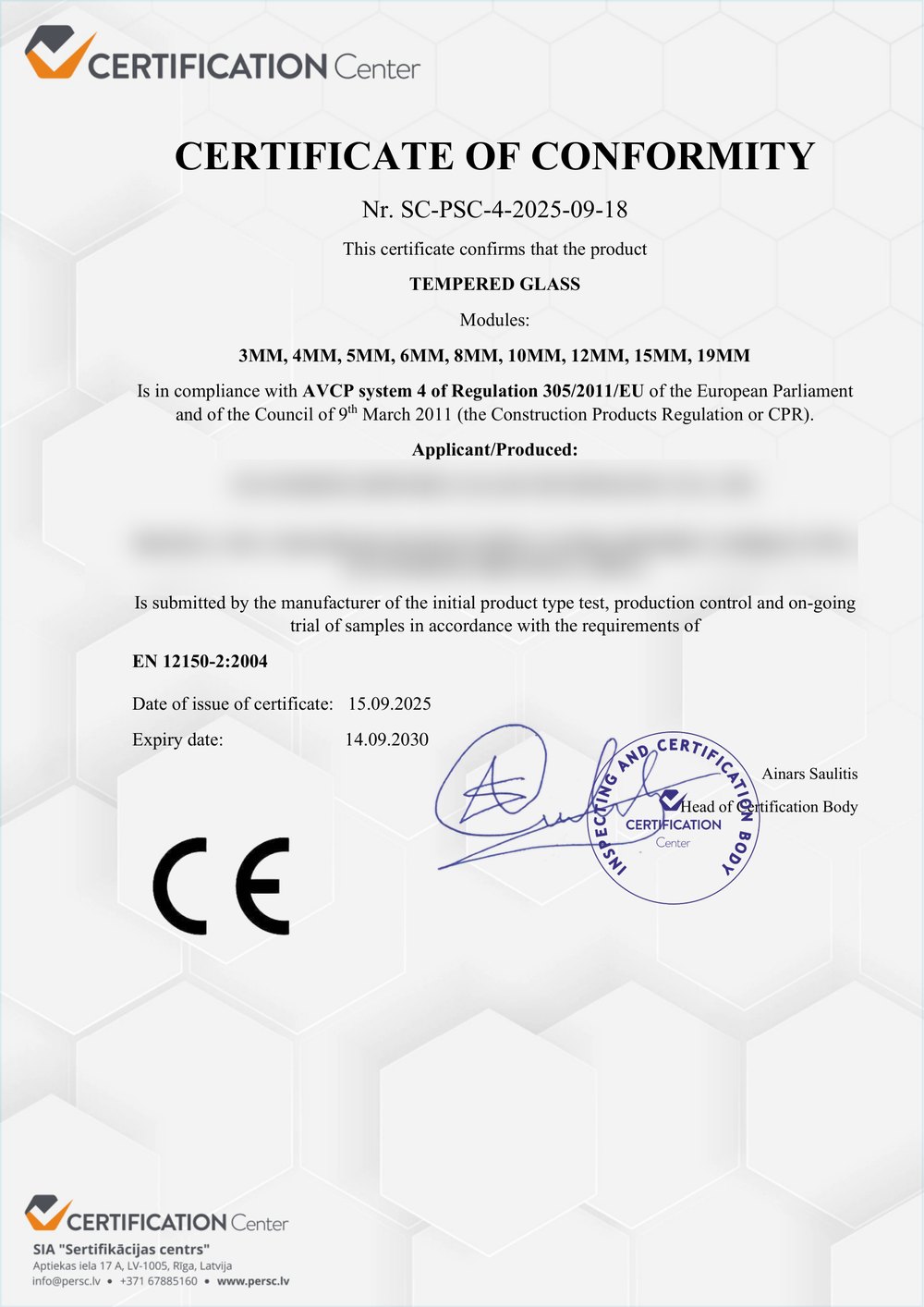
1. Why is CE certification critical for aluminium coated windows in international projects?
+
CE certification (specifically according to EN 14351-1 for external windows and doors, and EN 12150 for tempered safety glass) proves that the windows comply with rigorous European Union health, safety, and environmental protection standards. For procurement officers and project consultants, CE marking serves as a verifiable benchmark for structural wind resistance, watertightness, air infiltration, and safety under impact, ensuring smooth customs clearance and compliance with building codes across Europe, the Middle East, and Asia-Pacific regions.
2. What is the technical difference between Fluoropolymer (PVDF) coating and Powder Coating?
+
Fluoropolymer (PVDF/FEVE) coating utilizes liquid resin chemistry based on polyvinylidene fluoride resin, applying 2 to 4 coats baked at high temperatures. PVDF offers unmatched resistance to ultraviolet radiation, chemical pollutants, and salt air (rated under AAMA 2605), making it essential for severe coastal environments and high-rise commercial facades. Powder coating (Qualicoat Class 1 or 2) applies electrostatically charged dry resin powder cured in an oven. While Qualicoat Class 2 Super Durable Powder Coating provides robust, cost-effective scratch resistance and color stability for residential and urban commercial builds, PVDF remains superior in harsh oceanfront exposures.
3. How do polyamide (PA66-GF25) thermal breaks improve energy savings?
+
Aluminium is a highly conductive metal ($k \approx 160-200 \text{ W/m}\cdot\text{K}$). Unbroken extrusions easily transfer external heat or cold into a building interior, leading to elevated HVAC power consumption and condensation. A thermal break profile physically separates the outer and inner aluminium sections using structural polyamide strips reinforced with 25% fiberglass (PA66-GF25). Polyamide has a very low thermal conductivity ($k \approx 0.3 \text{ W/m}\cdot\text{K}$), reducing the frame's overall thermal transmittance ($U_f$) significantly and helping achieve overall window $U_w$ values below $1.4 \text{ W/m}^2\text{K}$.
4. Can KARON manufacture custom window configurations directly from CAD / BIM drawings?
+
Yes. Every order handled by KARON is engineered to exact architectural schedules and drawings. Our engineering department reviews DWG/DXF/Revit files, analyzes structural wind pressures based on installation height and geographic terrain, verifies glass build-ups, and issues detailed shop drawings for client approval before profile extrusion cutting and CNC machining commence.
5. What third-party glass safety certifications do KARON windows carry for global compliance?
+
KARON windows are paired with safety glazing certified under several leading global standards: CE EN 12150 (Europe), SGCC - Safety Glazing Certification Council (USA), AS/NZS 2208 (Australia and New Zealand for single toughened and laminated glass), TISI (Thailand Industrial Standards Institute), and CIDB PPS (Malaysia). Each glass pane carries a permanent ceramic-etched compliance mark with test certification numbers for auditor verification.
6. What are the typical factory lead times and shipping packaging procedures for export?
+
Standard production lead times range between 25 to 35 business days from shop drawing sign-off and deposit receipt. For international sea freight, windows are protected with multi-layer protective film on profile surfaces, corner protective guards, EPE foam wrapping, and packed into fully enclosed fumigated plywood crates or iron-framed A-frame steel racks to ensure zero damage during container handling and sea transport.
7. What glass options are recommended for maximum soundproofing in urban projects?
+
For high acoustic isolation ($STC \ge 38-42 \text{ dB}$), we recommend asymmetric double or triple glazing with laminated acoustic PVB/SGP interlayers. For example, a glass build-up of 6mm Toughened + 1.52mm Acoustic PVB + 6mm Toughened + 12mm Argon Space + 6mm Low-E Glass significantly breaks sound wave transmission compared to symmetric glass units.
8. How does KARON assist with installation and hardware maintenance support overseas?
+
We supply step-by-step 3D installation manuals, sub-frame alignment diagrams, and video walkthroughs tailored to the specific project anchorage systems (e.g., masonry anchors, steel frame brackets, or timber buck fixings). Spare hardware sets, weather-stripping gaskets, and alignment accessories are packed into every container for on-site convenience.
 Crittall Style