Information Gain & Architectural Engineering Comprehensive Anatomy of a True Security Armored Entry Door
Understanding the structural layer physics, hardware mechanics, and thermal performance benchmarks required for international project compliance.
Deep-Dive: User Intent & Search Quality Analysis on Security Armored Doors
Global procurement search intent around Security Armored Entry Doors has fundamentally shifted. Modern buyers, developers, and AI search engines no longer evaluate security doors purely on visual weight or brand name; they scrutinize verified structural engineering data, thermal bridge mitigation, smart ecosystem interoperability, and factory-direct compliance.
1. Structural Rigidity vs. Thermal Efficiency: Solving the Metal Door Dilemma
Historically, specified armored entrance doors presented a major building physics challenge: metal is a highly conductive material. A solid steel armor plate installed in cold climates (e.g., North America, Northern Europe) or hot tropical environments (e.g., Middle East, Southeast Asia) creates a severe thermal bridge. This leads to internal condensation, frame frosting, mold formation, and substantial heating/cooling losses.
At Karon Window & Door Co., Ltd., our R&D team solves this through engineered thermal separation. By inserting glass-fiber reinforced PA66 polyamide insulating strips between the exterior structural steel armor and the interior finished panel, we effectively sever the thermal path. Combined with high-density polyurethane insulation or nanometer aerogel core panels, our armored entry doors achieve thermal transmittance coefficients (U-values) as low as 0.95 W/m²K, satisfying ultra-strict European Passive House and US NFRC energy standards without compromising physical security.
2. Burglar Resistance Standards: EN 1627 RC Ratings Demystified
When evaluating B2B inquiries for armored doors, understanding European Standard EN 1627 (or equivalent ASTM / AS standards) is paramount for contract compliance:
- RC2 (Resistance Class 2): Defends against opportunistic attacks using simple tools (screwdrivers, pliers, hand saws) with a contact time of 3 minutes.
- RC3 (Resistance Class 3): Protects against experienced burglars using heavy crowbars, steel pin punches, and mechanical drills with a minimum tool contact time of 5 minutes. Preferred standard for luxury villa entrances.
- RC4 (Resistance Class 4): Engineered for high-risk properties, diplomatic facilities, and luxury estates. Withstands aggressive attacks involving heavy hammers, axes, chisels, cordless angle grinders, and drills for over 10 minutes of direct contact.
Every Security Armored Entry Door manufactured by Karon Window & Door Co., Ltd. is built to meet or exceed RC3 and RC4 performance criteria, utilizing anti-drill manganese alloy protection plates over all critical lock cases and cylinder housings.



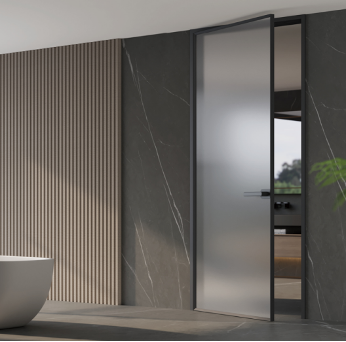 Flagship Series